The Deliverome Project: Mapping the "Molecular Addresses" to Solve Biopharma’s Persistent Delivery Bottleneck

By Sasha Stafford Principal Scientist & Founder, Elixis Biosciences LLC
In the modern era of precision medicine, we possess an unprecedented toolkit of therapeutic payloads. Today’s scientists can engineer CAR-T cells to eradicate blood cancers, design antisense oligonucleotides to silence harmful genes, and construct highly specific antibody-drug conjugates (ADCs). Yet, the promise of these revolutionary modalities consistently hits a physiological wall. The fundamental bottleneck in biotechnology is no longer identifying the disease target; it is the physical delivery of the therapeutic.
For those of us working closely with formulation science and bioengineering—navigating the complexities of lipid nanoparticles (LNPs), hydrogels, and complex emulsion systems—the challenge is intimately familiar. We can protect and package a nucleic acid or protein payload efficiently on the benchtop. However, ensuring that payload safely bypasses hepatic clearance, localizes to an extrahepatic tissue, and successfully penetrates the cell membrane of a specific target population remains a profoundly empirical, trial-and-error endeavor. We are, in many ways, attempting to deliver millions of microscopic packages without a map of the postal codes.
That paradigm is on the verge of a structural shift. Backed by a $5 million seed investment from the Astera Institute and an entrepreneurship award from the Hertz Foundation, the newly launched Deliverome Project aims to comprehensively map the human "surfaceome." Co-founded by scientists Becca Carlson and Bobby Hollingsworth, Deliverome is building the first open-access, large-scale atlas of human cell-surface proteins—specifically characterizing their ability to mediate intracellular delivery.

The Missing Map: Function Over Mere Expression
Historically, the biopharma industry has clustered its developmental pipelines around a remarkably narrow set of validated surface targets. It is estimated that we have explored less than 0.4% of the available surfaceome. While surface proteins account for roughly 15% to 20% of all proteins in the human body, they serve as the targets for more than 60% of FDA-approved drugs due to their accessibility to large biological medicines.
But merely identifying a receptor's presence on a cell membrane is insufficient for intracellular drug delivery. The Deliverome Project recognizes that a functional atlas must measure three distinct biological signals:
1. Abundance and Specificity: Quantifying which receptors are present on target tissues (and absent on off-target tissues) across healthy and diseased states.

2. Internalization: Determining which surface receptors actively facilitate uptake. A protein that simply resides on the membrane and transmits signals is structurally useless for delivering an mRNA payload into the cytosol. Researchers must identify receptors that undergo rapid receptor-mediated endocytosis when bound by a ligand or therapeutic vehicle.

3. Trafficking and Routing: Mapping the intracellular fate of the cargo. Once a vesicle pinches off into the cell, does the receptor route the payload to the lysosome for degradation, or does it facilitate endosomal escape into the cytoplasm or nucleus where the therapeutic can actually take effect?
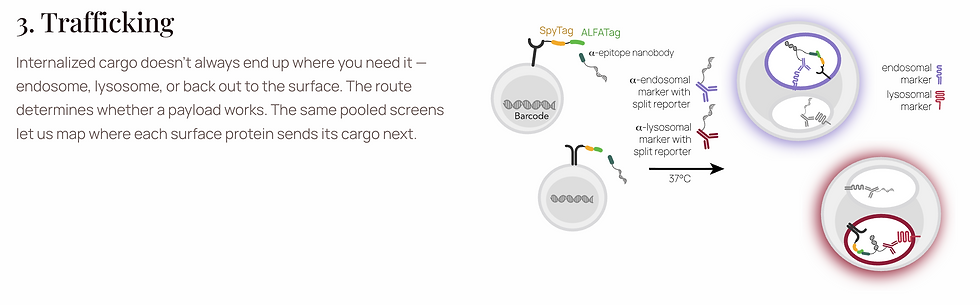

By integrating high-throughput quantitative mass spectrometry with pooled functional genomics screens, the Deliverome team plans to interrogate thousands of surface proteins simultaneously to answer these precise functional questions.
Implications for Formulation and Pipeline Development
Over the course of my 15 years evaluating technologies at the Wyss Institute and navigating commercial biotechnology translation, I have watched the industry grapple with the limitations of proprietary, siloed datasets. When platform companies keep surface protein data proprietary, the entire ecosystem suffers from redundant research and a high clinical attrition rate driven by off-target toxicities.
The Deliverome Project is structured as a Focused Research Organization (FRO)—a purpose-built nonprofit designed to tackle infrastructure-heavy scientific challenges that fall into the gap between academic capabilities and traditional venture-backed commercial timelines. Their commitment to open science means they will release protocols, reagents, and raw data continuously as "micro-publications."
For formulation scientists and biotech strategists, the implications of this open dataset are vast:
Unlocking Rare Disease Pipelines: Many rare genetic disorders boast well-understood molecular pathologies but lack a viable commercial therapy simply because the affected tissues cannot be reached safely. A comprehensive surfaceome map provides off-the-shelf "delivery handles," drastically lowering the barrier to entry for rare disease R&D.
Next-Generation LNP and ADC Design: Armed with quantitative data on receptor abundance and internalization rates, we can begin rationally designing the surface of LNPs and the linker-chemistries of ADCs to perfectly match the metabolic state and receptor density of the target tumor or tissue.
AI and Machine Learning Integration: Deliverome is formatting its findings specifically for computational discovery. By ingesting this multi-modal dataset, machine-learning models will soon be able to predict the most efficient, non-obvious receptor-cargo pairings, moving biological targeting from a reactive screening process to a proactive engineering discipline.
Moving Forward
The launch of the Deliverome Project represents a maturation in how our industry approaches structural biology. It acknowledges that the complexity of cellular trafficking cannot be solved by one company in isolation.
At Elixis Biosciences, optimizing the interface between a drug delivery vehicle and the patient's biology is central to our mission. As the Deliverome team opens its laboratory this year and begins releasing its functional maps, we anticipate a massive acceleration in the development of tissue-specific therapeutics. By finally treating delivery as an engineering problem driven by standardized, open-access data, the biopharma ecosystem is taking a critical step toward fulfilling the ultimate promise of precision medicine.


Comments